














← Education Hub / Bowling History
FROM 3200 BC TO TODAY
A 5,000-Year History of Bowling
From Egyptian tomb artifacts to PBA Tour broadcasts. The story of the world’s oldest ball game, the people who shaped it, and the technology that keeps changing how it is played.
By the BowlersMart Editorial Team. Sourced from the Bowling Hall of Fame archives, PBA records, and historical research. Last reviewed 2026.
THE MILESTONES
Bowling, in 10 Moments
Every major turning point that brought us from rolling stones in the Nile valley to the modern PBA Tour.
CIRCA
3200 BC
Ancient Egypt
Sir Flinders Petrie unearths primitive stone bowling balls and pins from the grave of an Egyptian child. The oldest known evidence of the sport.
CIRCA
1100s
Medieval England
Bowling takes root in England. By the 1300s, variations like half-bowls, skittles, and ninepins are played across Europe.
BEFORE
1670
Bowling Crosses the Atlantic
English, Dutch, and German immigrants bring lawn bowling and ninepins to colonial America.
YEAR
1841
Ten-Pin Bowling is Born
Connecticut bans nine-pin lanes to curb gambling. Players add a tenth pin to skirt the law. The modern game is accidentally invented.
YEAR
1895
ABC Founded
The American Bowling Congress standardizes rules, lane dimensions, and pin specifications, giving the sport its first national governing body.
YEAR
1958
PBA Founded in Syracuse
Sports agent Eddie Elias gathers 33 charter members, including Don Carter and Billy Welu, to form the Professional Bowlers Association.
YEAR
1962
Bowling Hits Prime Time
ABC begins televising the PBA Tour. Saturday afternoon bowling becomes a household routine for two decades.
YEAR
1991
The Reactive Era
Nu-Line Industries introduces the first reactive resin coverstock. Ball motion is revolutionized overnight; 300 games become routine.
YEAR
2005
USBC Replaces ABC
The United States Bowling Congress unifies the ABC, WIBC, YABA, and USA Bowling under one governing body for the sport.
ERA
2010s
Two-Handed Revolution
Jason Belmonte popularizes the two-handed delivery and rewrites the PBA record book. The sport’s biggest stylistic shift since the reactive ball.
3200 BC TO 1600 AD
Ancient and Medieval Origins
Long before pinsetters and reactive coverstocks, the game was just rolling stones at standing targets. It was probably the first ball sport humans ever played.
Egypt, 3200 BC
In the 1930s, British anthropologist Sir Flinders Petrie discovered objects in the grave of an Egyptian boy that he identified as primitive bowling balls and pins. Carbon dating placed the artifacts at over 5,000 years old. If correct, bowling predates the wheel. The grave contained nine pieces of stone meant to be set up as pins, plus a small stone ball and a marble arch used as a starting line. Pharaohs may have bowled.
Greece and Rome
The Greeks called their version kerlinger, played with stones and sea shells. The Romans played bocce, a target game where the goal was to roll a ball as close as possible to a smaller target ball. Bocce survived almost unchanged and is still played today in parks and clubs around the world. Roman soldiers carried the game across Europe during the empire’s expansion.
Medieval Europe
Bowling took root in England by the early 1100s. Over the next three centuries the game splintered into local variations: half-bowls, skittles, kayles, lawn bowls, and ninepins. King Henry VIII was an enthusiastic bowler. So enthusiastic, in fact, that in 1541 he banned commoners from playing because so many soldiers were neglecting their archery practice.
1670 TO 1900
The American Game
How a European pub sport became America’s most popular indoor pastime, and how a Connecticut gambling law accidentally invented modern ten-pin.
Colonial Bowling
English, Dutch, and German immigrants brought their versions of bowling to America sometime before 1670. New York City still has Bowling Green, named for the lawn bowling field that operated there during the colonial era. Washington Irving’s 1819 story “Rip Van Winkle” features ninepins prominently, suggesting the game was already part of American folk culture by the early 1800s.
The Accidental Invention of Ten-Pin (1841)
By the 1830s, ninepin bowling had become so associated with gambling and crime that Connecticut banned the game outright in 1841. The law specifically prohibited “nine-pin bowling alleys.” Resourceful proprietors added a tenth pin and reopened, technically operating “ten-pin” lanes, which were not banned. The modern game was born from a regulatory loophole. Other states followed Connecticut’s lead, and ten-pin spread nationally as nine-pin disappeared.
Standardization (1895)
For most of the 19th century, every region had its own rules. Lane lengths varied. Pin sizes varied. Ball weights varied. In 1895, a group of bowling proprietors and players met in New York City to form the American Bowling Congress (ABC), the sport’s first national governing body. The ABC established the lane and pin specifications still in use today: 60 feet from foul line to head pin, 41-1/2 inches wide, ten pins set in a triangle 12 inches apart.
1958 TO PRESENT
The Birth of Professional Bowling
How a lawyer in Ohio, 33 charter members in Syracuse, and a Saturday afternoon TV slot turned bowling into a professional sport.
Eddie Elias and the Charter Class (1958)
Eddie Elias was an Akron sports agent and attorney who saw bowling’s potential as a professional sport. In 1958, at the American Bowling Congress tournament in Syracuse, New York, he convened 33 of the country’s best bowlers and formed the Professional Bowlers Association. The charter members included names that would define the sport’s first golden era: Don Carter, Billy Welu, Carmen Salvino, Buzz Fazio, and Dick Weber.
The First PBA Tour (1959)
The PBA’s inaugural season featured three events. Italian-born Lou Campi of Dumont, New Jersey won the Empire State Open, the very first PBA title in history. Dick Weber, who would become one of the sport’s all-time greats, won the other two: the Paramus Eastern Open and the Dayton Open. By the early 1960s, the tour had grown to dozens of stops.
Television Era (1962 to early 1990s)
In 1962, ABC began broadcasting the Pro Bowlers Tour on Saturday afternoons. The show became a cultural fixture. Chris Schenkel called the action. Earl Anthony, Mark Roth, and Marshall Holman became household names. At its peak, Saturday bowling drew bigger TV audiences than golf or tennis. The show ran continuously until 1997, an unbroken 35-year run.
HALL OF FAMERS
Faces of Bowling
A short list of the people whose names anyone serious about the sport should know.
CHARTER MEMBER
Don Carter
1926 to 2012
Six-time Bowler of the Year. The face of bowling’s first golden era. First athlete in any sport to sign a million-dollar endorsement deal.
CHARTER MEMBER
Dick Weber
1929 to 2005
26 PBA titles. Won the first two tournaments of the 1959 PBA season. Father of Pete Weber, the second-generation Hall of Famer.
PRO TOUR LEGEND
Earl Anthony
1938 to 2001
43 PBA titles. The first bowler to surpass $1 million in career earnings. Left-handed precision personified.
PRO TOUR LEGEND
Walter Ray Williams Jr.
Born 1959
All-time PBA wins leader with 47 titles. Seven-time PBA Player of the Year. Also a six-time world horseshoe champion.
MODERN ERA
Pete Weber
Born 1962
37 PBA titles. Ten majors. One of the most charismatic and outspoken players in the sport’s modern era.
MODERN ERA
Jason Belmonte
Born 1983
Australian. 15 majors and counting, the all-time leader. Popularized the two-handed delivery that has reshaped the modern game.
CURRENT GENERATION
EJ Tackett
Born 1992
Multiple-time PBA Player of the Year. Sustained the modern PBA’s competitive depth alongside Belmonte and a new wave of two-handers.
WOMEN’S TOUR
Liz Johnson
Born 1973
PWBA Hall of Famer. 27 PWBA titles. The face of women’s professional bowling through the sport’s most recent generation.
Want a first-hand account? Read The Bowling Memoirs of Johnny Petraglia, a Hall of Famer with three PBA titles in 1971 alone, written exclusively for BowlersMart.
1990 TO TODAY
The Modern Era
Two technologies, one stylistic revolution, and a sport that looks almost nothing like what Don Carter played.
Reactive Resin (1991)
For most of bowling’s history, balls were made from plastic or polyester. In 1991, Nu-Line Industries introduced a coverstock made of reactive urethane resin that grabbed the lane like nothing before it. Carry percentages jumped overnight. The number of sanctioned 300 games went from a few hundred per year to tens of thousands. Today’s high-end balls use asymmetric cores with reactive solid or pearl covers, generating motion shapes that would have been impossible to produce thirty years ago.
Two-Handed Bowling
Jason Belmonte arrived on the PBA Tour in 2008 throwing the ball with two hands and no thumb. Traditionalists were skeptical. Then he won, repeatedly, with rev rates that bordered on physics-defying. The two-handed approach is now the dominant style among the sport’s top players. EJ Tackett, Anthony Simonsen, and a new generation of teenagers have built their games around the technique. Equipment manufacturers responded with layout systems like Storm’s 2LS that are purpose-built for the no-thumb release.
PBA on Streaming and Cable
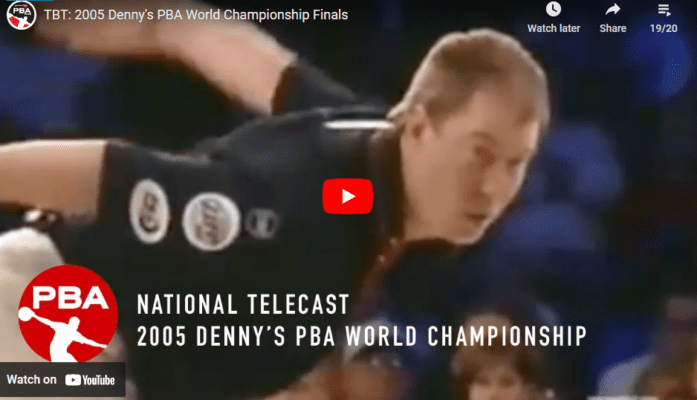
After ABC’s 35-year Saturday afternoon run ended in 1997, the PBA spent two decades on cable (ESPN, FOX) finding its modern television rhythm. The 2020s brought the sport into the streaming era, with most tour stops available on FOX Sports digital and PBA Bowling Channel. The audience is smaller than the 1970s peak, but the international reach is larger than ever.
DEEPER READING
Latest History Articles
Hundreds of articles on bowling people, places, and equipment from the BowlersMart editorial archive.






Keep Exploring
REFERENCE
Bowling Terms Glossary
A-Z reference of every bowling term, from approach to wood pin.
FIRSTHAND ACCOUNT
Petraglia Memoirs
Hall of Famer Johnny Petraglia’s bowling memoirs, written exclusively for BowlersMart.
CURRENT NEWS
Today’s Bowling News
What is happening in bowling right now: tournament results, equipment launches, industry updates.
CONTINUE LEARNING
5,000 years of bowling, and you are part of the next chapter.
From Egyptian stone artifacts to your league lanes tomorrow night. Browse the rest of the BowlersMart education hub for tips, coaching, and technical research that builds on the history you just read.
 Balls
Balls Shoes
Shoes Bags
Bags Accessories
 Apparel
 Deals
Deals