

LEVEL 2
Intermediate

Intermediate Bowling Tips: Break 150 and Build a Real Game

You can hit the pocket. Now make it happen on every shot. Consistency, your first drilled ball, real lane adjustments, and a spare system that turns 140 averages into 170s.

By BowlersMart Team
Last reviewed: May 18, 2026
Read time: 13 min

Where You Are

Intermediate bowlers know HOW to bowl. The next jump comes from (1) repeating the same release every shot, (2) learning to read what the lane is telling you, (3) getting your first drilled ball with a fingertip layout, and (4) building a spare system instead of guessing. Locking those four in is the difference between averaging 130 and averaging 170.

The Consistency Foundation

Power and hook do not raise your average. Doing the same thing twice in a row does. These four habits separate the 130 bowler from the 170 bowler.

Habit 1

Repeatable tempo

Count “one-two-three-four” the same way every shot. Inconsistent footwork is the single biggest source of inaccuracy at this level.

Drill

Bowl 5 shots in a row with your eyes closed for the last two steps. Forces you to commit to a rhythm instead of steering.

Habit 2

Same release every time

Your thumb should exit at the same point in the swing on every shot. Watch your finish, your bowling hand should pose in the same position every time.

Drill

Pose your finish for a full second after every shot. Self-corrects sloppy follow-throughs faster than any verbal cue.

Habit 3

Pick a target, hit it

Pros aim at arrows or breakpoint dots, not at pins. Pick a board 15 feet downlane and roll the ball over it. Pin contact is the result, not the goal.

Drill

Throw 10 shots at the second arrow from the same standing spot. Track which board your ball actually crosses. That gap is your targeting error.

Habit 4

One change at a time

When something is off, change one variable. Speed, target, or feet. Not all three. Changing multiple things at once means you cannot tell which one fixed it.

Drill

Throw three shots after every change. If two out of three are better, the change worked. If not, change back and try a different variable.

Reading Your Ball Reaction

Once you can repeat your shot, the next skill is learning what the ball is trying to tell you about the lane.

Watch this

The breakpoint

That is where the ball stops sliding and starts hooking back. If your breakpoint moves left game over game, the lane is breaking down. If it moves right, the oil is migrating.

Watch this

Entry angle to the pocket

Strikes happen at a 4 to 6 degree entry angle. Too steep, you split the 8-10. Too shallow, you leave corners. Your eye learns this faster than you think.

Watch this

Pin action

A solid pocket hit that leaves the 7 means a light hit. A pocket hit that leaves the 10 means flat. The corner pin tells you what the ball did at the pins.

Lane Adjustments 101

Two boards left, one board right, change speed, change target. The intermediate bowler’s toolkit, simplified.

If you are leaving… First adjustment If that does not work
10 pin (right-handed) Move feet 1 board right, keep target Add a touch of speed to push the ball further down the lane
7 pin (right-handed) Move feet 2 boards left, keep target Slow the ball down to give the hook more time to develop
Splits (8-10, 5-7) Check entry angle, you are coming in too steep or too flat Move feet 2 right and target 1 right (the 2-1 rule)
Ball going through the nose (1-2) Move feet 2 left, target 1 left (parallel move) Lane is hooking too much, slow down or move to a smoother ball
Ball gutters or misses right Move feet 2 right, target 1 right Lane has stopped hooking enough, ball change to something stronger

The “3-2 rule” is your shortcut: move 3 boards with your feet, 2 with your eyes, in the same direction. Forces the ball further inside while keeping the breakpoint roughly the same.

Your First Drilled Ball

The biggest single jump in your average comes from a ball that fits your hand and is built for the conditions you actually bowl on.

Choose

An entry to mid-level reactive ball

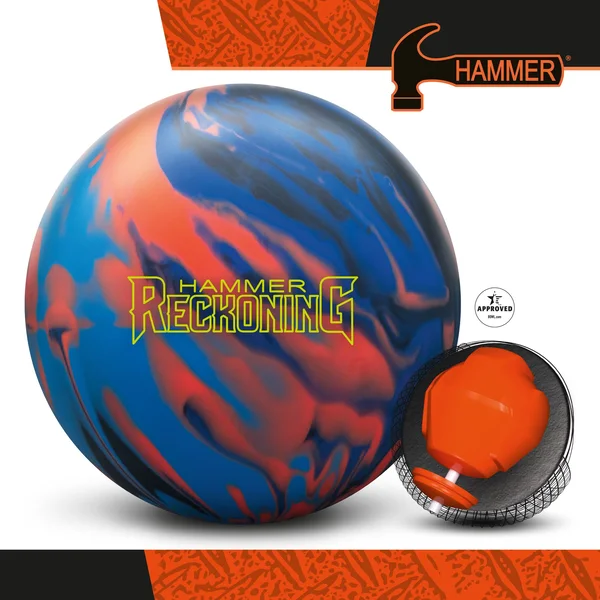
Not a premium tournament ball. Not a polyester spare ball. Something in the $120 to $180 range, drilled fingertip to your hand. Lines like Storm Phaze, Hammer Black Widow Smashed, Brunswick Quantum entry, or Roto Grip Hustle are the sweet spot.

Why: Forgiving enough to score on house shots, modern enough to read the mid-lane the way today’s lanes demand.

Add a spare ball

A polyester spare ball, drilled the same

Shoot all single-pin spares with a polyester ball that does not hook. Eliminates lane-condition guesswork on the spare shot. Storm Tropical, Brunswick T-Zone, and Motiv Press are the standards.

Why: Spares are roughly half your score. A 2-ball arsenal with a plastic spare ball typically adds 10 to 15 pins to your average overnight.

The 3-6-9 Spare System

The simplest spare system in bowling. Pick a strike target, then shift your feet by a fixed number of boards depending on which pin you are shooting.

3

Move 3 for the 4 pin

Move 3 boards toward your strike side. Same target. The shallower the spare, the smaller the move.

6

Move 6 for the 7 pin

Move 6 boards from your strike position toward the strike side. Same target. The deep corner pins need the biggest move.

9

Move 9 for the 10 pin

For right-handers, move 9 boards to the LEFT (opposite side) for the right corner. Aim at the same target arrow. Straight line, clean make.

All of these assume you are throwing your spare ball (or a straight ball with the plastic in the bag). Hooking your spare ball at single pins is the fastest way to leave open frames for years.

[/col] [/row]

Practice With a Purpose

Bowling 10 random games is not practice. These four drills build skills your league nights will reward immediately.

10-Spare Set

Set up every single-pin spare manually (or have the desk reset just the corner pin). Make 10 in a row. Forces your spare game without the noise of a full game.

3-Board Window

Throw 20 shots and try to keep your ball inside a 3-board window at the breakpoint. Builds the targeting precision that scores on tighter patterns.

Tempo Reset

Bowl 10 shots while counting “one-two-three-four” out loud. Slowing the tempo on purpose cures rushing the line, the most common cause of inconsistency at this level.

Move and Reset

After every strike, intentionally move 2 boards inside and throw the next shot. Trains you to make adjustments under success, not just under failure.

When to Hire a Coach

You are ready for your first real lesson

If your average is stuck in the 140s and you cannot tell what is holding you back, one hour with a USBC-certified coach is the cheapest improvement you will ever buy. They see what you cannot see. Most BowlersMart locations have a coach available, or visit John Gaines’ Coaching Corner for fundamentals video work.

Visit the Coaching Corner โ†’

๐ŸŽฏ

FAQ

Why am I stuck averaging 140-150?
Almost always one of three things: inconsistent release, poor spare conversion, or a ball that does not match the lane condition. Track your spares for one week and check that you are converting more than 60% of single-pin spares. If you are not, that is your bottleneck. If you are, your strike game needs work, usually on consistency, not power.
$120 to $180 covers the ball plus a fingertip drilling at a pro shop. You can find solid entry-level reactive balls for $90 to $130 ball-only, with $40 to $60 for drilling on top. Do not jump straight to a $250 premium ball, you will not use the extra performance until your release is more developed.
Maybe. A simple wrist brace (cock-and-lock style) can help if your wrist collapses at release. The risk is that it can mask form issues. If you use one, take it off occasionally in practice and work on the form your wrist would normally collapse from. Goal is to need it less over time, not more.
The day you commit to a league. Even one league night a week justifies a fitted ball. The combination of consistent fit, fingertip drilling, and a reactive coverstock typically adds 15 to 30 pins to a beginner’s average immediately, and more as your form develops.
A house shot is the typical league pattern, with lots of oil in the middle of the lane and dry boards on the edges. It funnels almost any shot into the pocket. A sport shot is flatter, with much less margin for error in your aim and release. Intermediate bowlers should master house shots first, then start exploring sport patterns as part of moving toward Advanced.
When you are averaging 170+ on house shots, converting most spares, and starting to find house shots predictable. If you have ever thought “I want to try a sport pattern” or “I should build a real 3-ball arsenal”, you are ready to step up.
Level 3 Next

Ready for the Advanced Guide?

When you have your release locked in, your spare system clicking, and you are averaging 170+, it is time to start thinking like a tournament bowler. Sport patterns, arsenal building, transition strategy.

Go to Advanced โ†’

Intermediate Reading List

Lane Play

Oil Carry Down vs. Break Down

Reading the lane transition that breaks 140 averages.

Read it โ†’

Equipment

Fingertip vs. Conventional

Why your first drilled ball should be fingertip, and how to make the transition.

Read it โ†’

Drilling

Drilling Layout Guide

How pin-to-PAP, VAL, and core orientation shape your ball reaction.

Explore โ†’